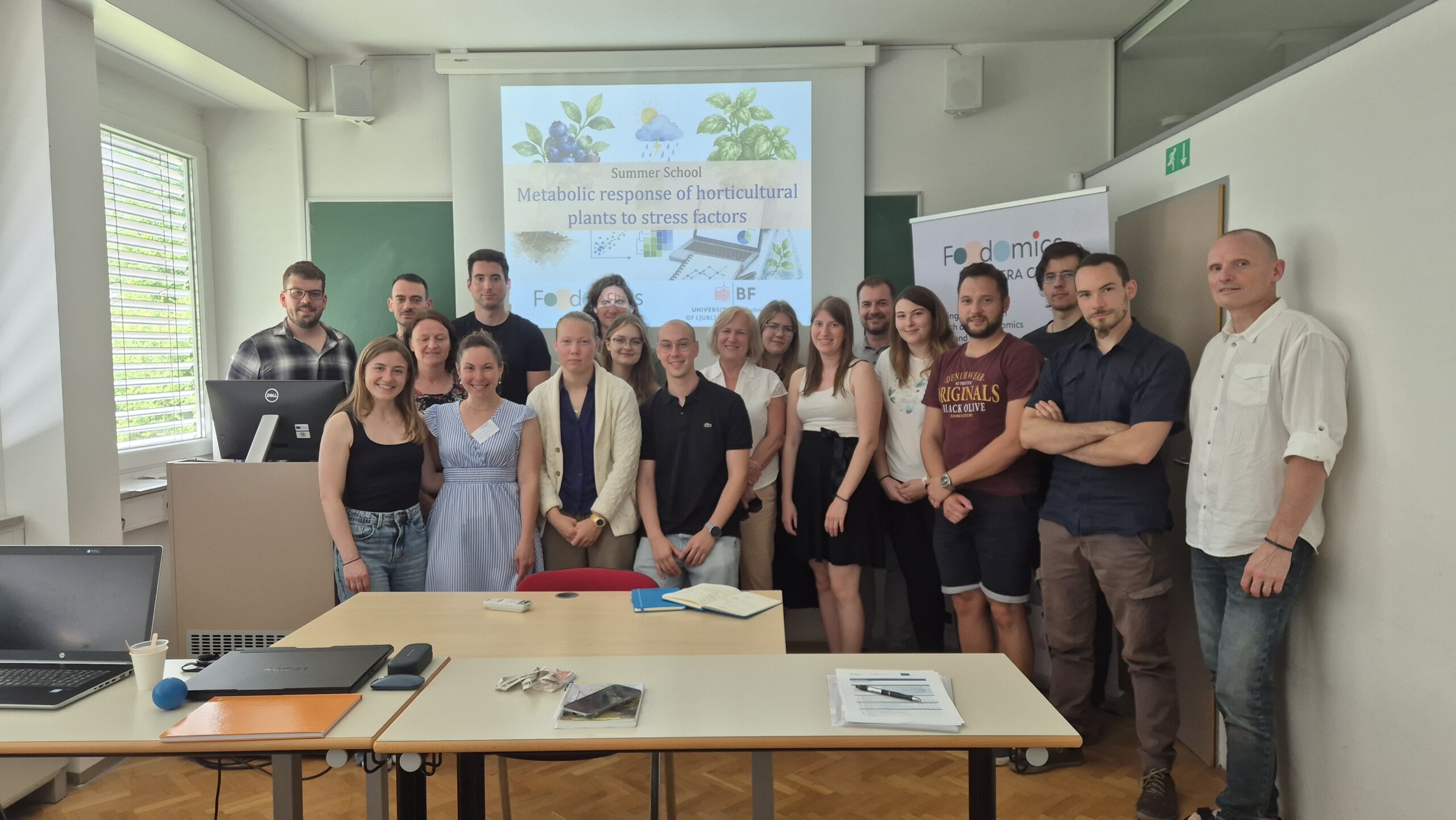
The Summer School Metabolic Response of Horticultural Plants to Stress Factors was successfully held from 14 to 20 June 2026 at the Biotechnical Faculty, University of Ljubljana. The programme was organised within the ERA Chair FOODOMICS project in collaboration with the Department of Agronomy.
The week brought together early-stage researchers from different countries and scientific backgrounds, creating a dynamic and highly interdisciplinary learning environment focused on plant stress physiology, metabolomics, and modern analytical approaches in horticultural science.
Throughout seven intensive days, participants explored how environmental stress factors such as drought, salinity, and heat affect plant physiology, metabolism, and the quality of horticultural products. The programme combined lectures, laboratory training, data analysis sessions, group work, and field-based learning, offering a unique hands-on experience across the full research workflow.
A strong emphasis was placed on practical training with modern phenotyping tools and advanced analytical techniques, including HPLC, LC-MS/HRMS, and GC-MS. Participants worked with real experimental systems involving basil under salinity stress and blueberry under drought stress, allowing them to directly connect physiological responses with metabolic changes and quality traits.
The summer school also provided valuable insight into data analysis and interpretation of complex biological datasets, including multivariate statistical approaches and visualisation techniques. These skills are increasingly important in modern plant and food science research.
Beyond laboratory and analytical work, the programme strongly encouraged collaboration, discussion, and scientific exchange. Participants actively engaged in group work and presentations, strengthening their communication skills and ability to interpret and present scientific results in an interdisciplinary setting.
A highlight of the programme was the field excursion to the experimental orchard at Brdo pri Lukovici (Agricultural Institute of Slovenia), where participants were introduced to innovative technologies for sustainable horticultural production, including precision spraying systems and agrivoltaic solutions.
The summer school provided participants with a comprehensive understanding of how environmental stress influences plant performance and product quality, while also strengthening their practical and analytical research skills. The combination of theory, hands-on training, and real-world applications was highly appreciated by participants and instructors alike.
The event further highlighted the importance of interdisciplinary collaboration and the growing role of advanced analytical and data-driven approaches in addressing challenges in modern agriculture.
A selection of moments and highlights from the summer school is presented below.