About Us
Metabolites produced by people, animals and plants during the process of building up and breaking down molecules are biomarkers of biochemical pathways, processes of health and disease and the effectiveness of interventions. Metabolomics refers to the large-scale study of all the metabolites present from the cell to the organism level. The EU-funded Foodomics project aims to create a world-class research centre in the field of metabolomics in food and nutrition at the University of Ljubljana. Focused on developing new analytical methods and providing measurement services related to metabolomics, Foodomics will strengthen Slovenia’s innovation capacity and accelerate start-up creation.
Mission and Vision
The vision of the ERA Chair FOODOMICS is to create a research centre at the University of Ljubljana (UL) in the field of Metabolomics in Food and Nutrition. The project will be implemented within the framework of the ERA Chair action in order to simultaneously realize the research potential of the UL and create a dynamic and sustainable state-of-the-art research environment. With the support of a network of existing international/regional/national partners, SMEs, and stakeholders, the research results will be made fruitful while t creating a springboard for UL to move from partial, small and fragmented research to bigger innovation driven projects that can provide solutions to society´s needs. FOODOMICS aims to promote scientific progress by developing new analytical methods and providing measurement services applicable to plants, animals and humans.
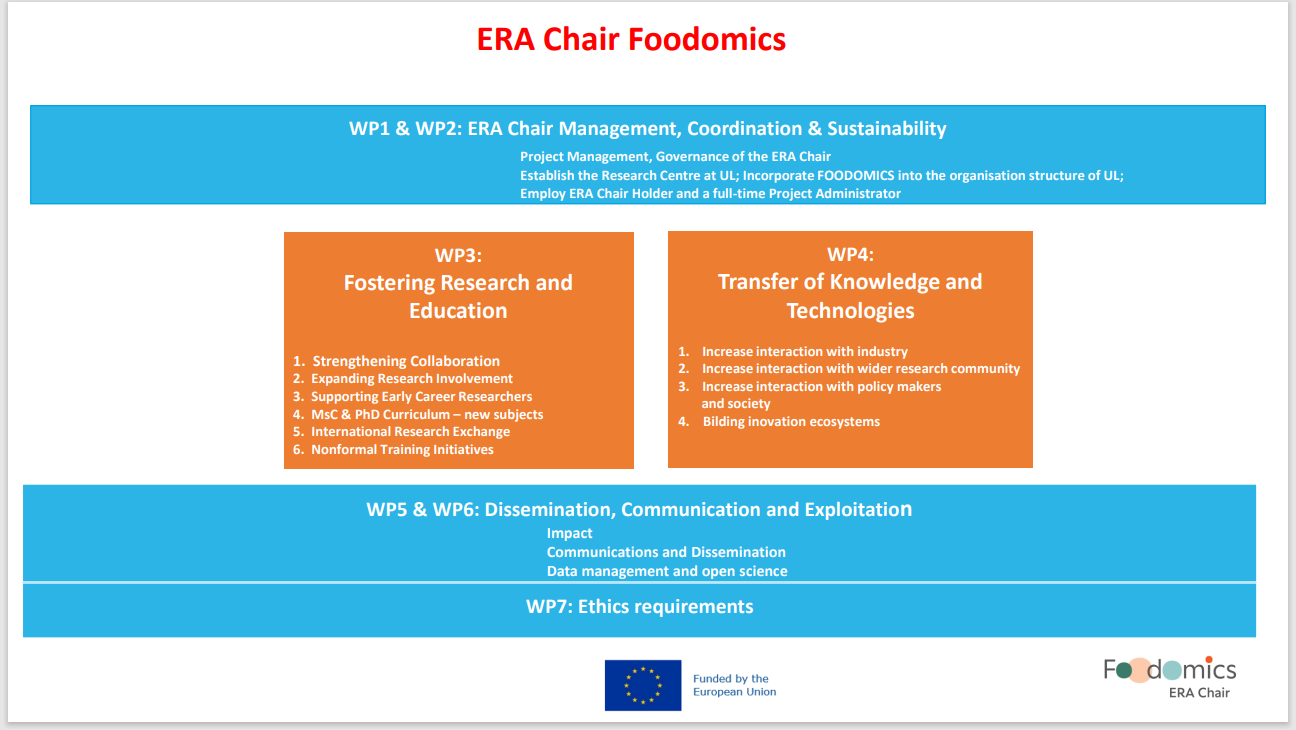
The activities will include both profiling (analyses of all measurable analytes to identify differences) and targeted analyses (quantification of a selected group of analytes). FOODOMICS comprises four work packages (WP) which are necessary for the required capacity building. Each of these WPs addresses a specific element required for the creation of a world-class Metabolomics Centre of Excellence for Food and Nutrition at UL. WP1 and WP2 are dedicated to three important topics: (i) management and coordination; (ii) constitution; and (iii) sustainability issues. WP3 is dedicated to the promotion of research and education. WP4 focuses on the transfer of knowledge and technologies. WP5 and WP6 will carry out comprehensive dissemination, communication and exploitation activities. An important outcome of this project is that the differences in research and innovation performance between Slovenia and the innovation leaders in the EU will be significantly reduced. The far-reaching impact of FOODOMICS will be the creation of a world-class working environment and centre of excellence, as well as innovative start-up companies that will, strengthen the Slovenian and European economy.
Our Directors


Our Project
The University of Ljubljana (UL) has a strong track record in research, with several researchers ranked among the top 2% worldwide in food and nutrition sciences (according to a Standford University database), and with h-indices above 20. However, limited international visibility has led to missed opportunities for engaging with cutting-edge research and innovation in the rapidly growing field of metabolomics in food and health.
This is the primary driver for wanting to create a research Centre of Excellence in Metabolomics headed by a world-class ERA Chair to grow our reputation and to contribute to, advance, and exploit state-of-the-art research and technological innovation, whilst impacting broader societal and EU goals in this field (e.g. Sustainable Development Goal 3: Good health and well-being).
Multi-omics Advanced technologies and scientific discoveries in these areas, combined with increasing public awareness and demand for sustainable, high-quality, nutritious, tailored diets, will create huge opportunity and benefit for all stakeholders.
Advanced technologies and scientific discoveries in these areas, combined with increasing public awareness and demand for sustainable, high-quality, nutritious, tailored diets, will create huge opportunity and benefit for all stakeholders.
The ERA Chair FOODOMICS will be designed to mediate progress in science through development of new analytical methods and provision of measurement services applicable to plants, animals and humans including their corresponding cell models. The ERA Chair will generate new holistic methods to improve the knowledge at the molecular level on nutritionally and sensorially significant compounds. As a new Centre of Excellence, it will widen the outreach of metabolomics to nutritional intervention studies, tracing the path of natural bioactive compounds inside the human body, investigating the human-microbial co-metabolism, and biomarker discovery and validation biomarkers. Such information has the ultimate goal of improving the understanding of the impact of diet on human health, particularly obesity and diabetes. Understanding the inter-individual variability in metabolism leading to different metabotypes (a necessary step toward translation into personalised nutrition), and producing higher value-added foods by applying the new processing technologies for improving food availability.
The ERA Chair will work on structural integration and setting up infrastructure to pursue the production of a critical mass of state-of-the-art datasets, suitable for the use within multiomic experiments, pursuing interdisciplinarity and embracing the principles of open science. Optimal circulation, access to, and transfer of scientific knowledge will be supported through digital ERA tools, promoting open sicence and ensuring that knowledge reaches citizens, civil society, and end users.
Objectives and Ambitions
The main actions through the ERA Chair will be to bring new competences and knowledge from its cutting-edge areas, such as advanced high throughout techniques for the chemical profiling of food and products of metabolism by employing the ERA Chair holder, dr. Urška Vrhovšek, who is a recognized and renowed expert in the field. Through connecting a wide array of fields and competences of UL, connecting national and international research activities as well as bringing the level of national R&D services up to date, this project will be a significant opportunity for the ERA Chair holder as well.
Methodology
To address all the Main Objectives of FOODOMICS, the concept, structure and organisation of the project will be realised through 4 work packages () led by established researchers in the field of metabolomics which will be able to bring the field forward under the guidance of prof. dr. Urška Vrhovšek as the ERA Chair holder. WP1 and WP2 are dedicated to three important issues: (i) management and coordination; (ii) constitution; and (iii) sustainability activities. WP3 is dedicated to grow research capacity and education, WP4 is dedicated to the transfer of knowledge and technologies and WP5 and WP6 are dedicated to dissemination, communication and exploitation activities.
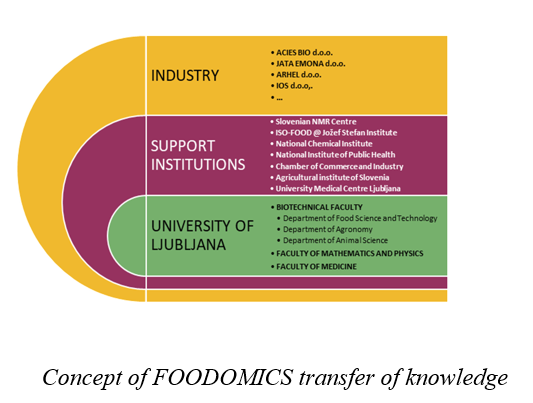
Analytical platform: Through the analytical platform in FOODOMICS, the ERA Chair will connect all infrastructure/equipment available at UL located at different faculties and at supporting institutions to serve the research and innovation and educational and knowledge transfer aims of FOODOMICS through joint research collaborations (through new projects, PhD students, postdoc researchers, master students) to create the sustainability of CoE.
Innovation: In the frame of FOODOMICS, the transfer of knowledge to research networks and industry will be promoted by the leading expert from advisory project board members to support exploitation and to offer the largest array of innovation strategies so that the participants can foster their existing experience.
The purpose of the ERA Chair project is to achieve sustainable operation of ERA Chair FOODOMICS upon project completion. The ERA Chair FOODOMICS will be an independent, leading research and education Centre in the field of metabolomics (Centre of Excellence) in food and nutrition at the UL.
Scientific Output of the ERA Chair FOODOMICS
In order to ensure an optimal circulation of the information and to guarantee a transfer of knowledge, all the scientific publications will be accessible via open access in repositories and on the web site of the published papers of ERA Chair website.
FOODOMICS will create an inter- and multi-disciplinary research environment. The FOODOMICS model offers exciting research potential, and when added to the ERA Chair team’s effort to create an open and dynamic learning environment will make the UL an exciting research and study proposition. The ERA Chair also believes in the free movement of researchers and access to knowledge. This includes ensuring open access to publications from the project. Also, with the exception of the final symposium, all other FOODOMICS workshops, summer schools, and public events will be free and open to the scientific community, stakeholders and citizens. Offering a competitive, international environment will aim to increase the competitiveness of young Slovenian researchers and a hub for active exchange and collaboration with internationally recognized scientists PhDs to sabbatical stages.
Collaboration with business: University of Ljubljana has already solid links with Slovenian and also EU food industry. One of the successful mechanisms is the Smart Specialization Program where UL participates as a R&D partner in the program Food for Future.
New products and services: Ideas that result from ERA Chair will be transferred to stakeholders and industry that offer numerous opportunities for the development of technologies, instrumental improvements devices, and products (Deliverable 4.4).
While scientific outputs will be freely available, other, potentially patentable, outputs (Deliverables D3.3). (e.g., novel bioactive compounds in plants that could be used in feed and food, development of new analytical methods; advanced processing technologies; new functional foods; food supplements; new biosensors; data platform for stakeholders from Research and Industry) will have commercial value.
Similarly, novel diagnostic markers can lead to innovations in predictive preventive personalised medicine. Innovation, tumours diagnostics and markers of prognosis represents a huge market potential – global diagnostics market, as in vitro tests, has an estimated worth US$ 40–45 billion.
Cooperation with Established ERA Chairs
ERA Chair FOODOMICS will collaborate with ISO-FOOD ERA Chair at Institute of Josef Stefan and play an active role in achieving its long-term goals and sustainability.
The ERA Chair FOODOMICS represents a step forward in the field of food quality and safety by introducing novel and state-of-the art methodologies based on metabolomics. In particular, ISO-FOOD, has established an extensive database and methodology in food origin determination by isotope analysis, whereas by introducing the metabolomic profiling capabilities several samples could be further refined or determined in samples which prove more difficult/ unsuitable for isotope studies.
The advanced knowledge gained through the ERA Chair FOODOMICS partnership will therefore complement activities of the ISO-FOOD by strengthening its infrastructure role, also because the virtual centralised coordination platform ISO-FOOD is planned in support of delivering complexity of diverse dissemination activities. There is also a mutual benefit in sharing open science, data management and big data processing practices. (ii) ERA Chair xxxx, already established at University of Ljubljana, is a project with an expressive interdisciplinary character within which colleagues from several teams who are already working on the development of
The ERA Chair will support the development of globally competitive helath services by enabling the rapid interation of new discoveries in nutritional disease prevention into therapeutic solutions. Through FOODOMICS, national and international expertise will be brought together, combining diverse scientic and professional competencies. This will also create a valuable public knowledge base, offering expert insight necessary for designing and implementing effective institutional strategies and public development asction plans.
A deeper understanding of metabolomics in human nutrition and identification of risk markers can significantly benefit both environmental and ecosystem helath. This knowledge will support the development of more targeted and effective public health strategies and interventions – at national level (e.g. Ministry of Agriculture, Forestry and Food; Ministry of the Environment and Spatial Planning) and at the EU level. It will also contribute to the creation of improved monitoring and ealr-warning tools, as well as to more efficient resource use, such as water reuse.